
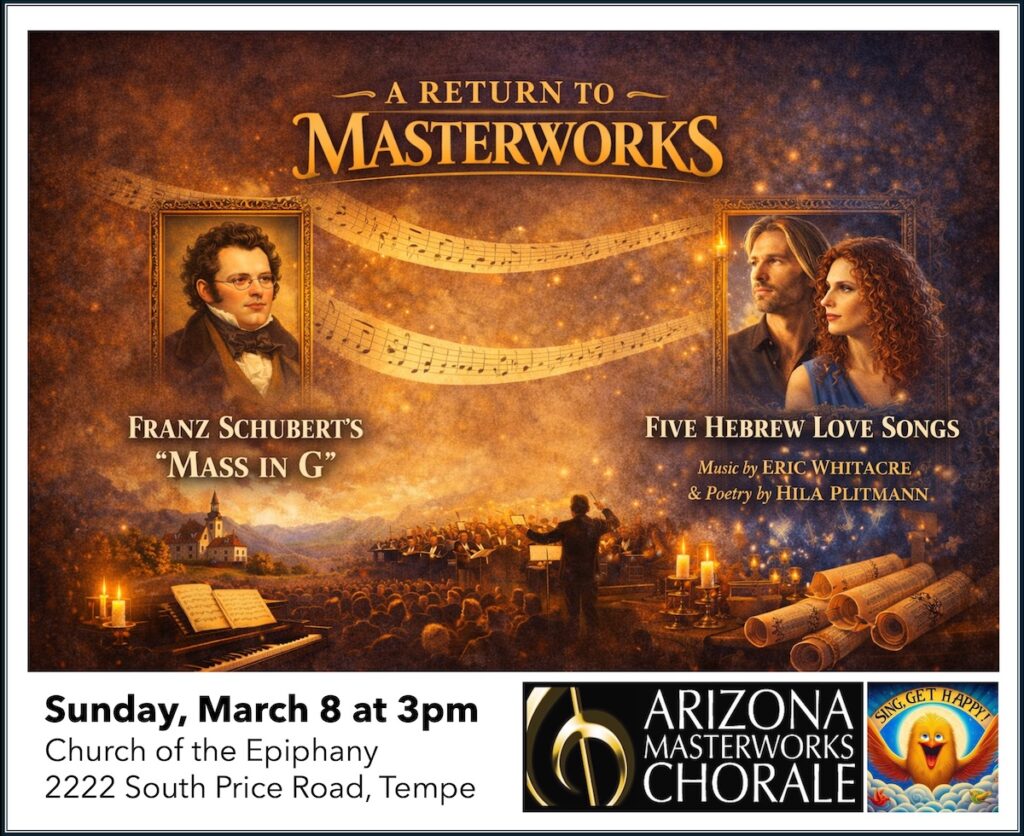
Centuries of choral beauty: A radiant Mass, written with youthful devotion and classical grace; the luminous Five Hebrew Love Songs, a modern cycle of poetry, tenderness, and joy; and the living lineage of sacred chant from its ancient roots to contemporary choral writing.
Franz Schubert was only eighteen years old when he composed our classic masterwork, his Mass in G, a work that carries a clarity and serenity far beyond its creator’s tender years. Unlike the grand symphonic masses of later Romantic tradition, this missa brevis is intimate, devotional, and built on graceful melodic arches that seem to lift effortlessly upward. The music feels less like public ceremony and more like personal prayer — simple, direct, and luminous.
(A missa brevis is designed for brevity and practicality. Composers across centuries—from Renaissance masters to contemporary writers—have embraced the form, finding ways to express depth and devotion within compact musical dimensions.)
Eric Whitacre’s contemporary masterwork, Five Hebrew Love Songs, comes from a completely different world, yet it shares the same spirit of emotional honesty. The five short movements are settings of love poems written in Hebrew by Hila Plitmann, Whitacre’s wife, when the two were young artists in New York. The texts are brief but rich in imagery: falling snow, quiet stillness, a rooftop speaking to the sky, a moment of love settling into “the softest, softest place.”
Finally, we illustrate the enduring art of sacred chant from its ancient roots to its resonant presence in contemporary choral writing as a living lineage—continually reimagined across centuries in sound, spirit, and communal voice. Selections from Byzantine Lenten Divine Liturgy chants open the journey with spare, modal melodies shaped by free rhythm and unadorned vocal color, allowing text and tone to merge in contemplative simplicity. From this foundation emerges the lush Romantic mysticism of the Cherubim Song by Pyotr Ilyich Tchaikovsky, where chant-inspired lines expand into glowing harmonies that seem to suspend time. The thread continues in the luminous austerity of Song for Athene by John Tavener, whose Orthodox inflections evoke ritual and remembrance. Finally, The Lord Is My Shepherd by John Rutter offers a pastoral, lyrical reflection that transforms chant’s inward devotion into radiant choral warmth.
Spanning centuries of sacred and poetic expression, the program weaves together luminous grace fand intimate lyricism with contemporary and ancient choral meditations in a rich tapestry of devotion, tenderness, and transcendent beauty.
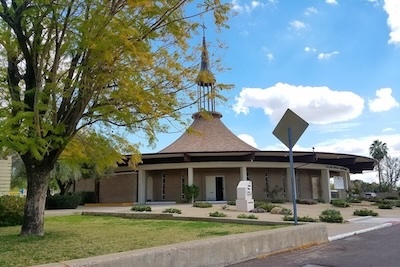
Saturday, March 7 at 4 PM
Orangewood Presbyterian Church, 7321 North 10th Street, Phoenix
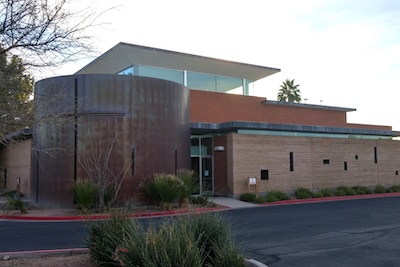
Sunday, March 8 at 3 PM
Church of the Epiphany
2222 South Price Road, Tempe
General Admission $20
Seniors & Students $15
12 and under free with paid admission
Concert Program
The Classic Masterwork
- "Kyrie" Andante con moto, G major, 3/4
- "Gloria" Allegro maestoso, D major, common time
- "Credo" Allegro moderato, G major, cut common time
- "Sanctus" Adagio moderato, D major, common time
- "Benedictus" Andante grazioso, G major, 6/8; canon"Osanna in excelsis..." D major, Allegro, 2/4
- "Agnus Dei" Lento, G major, common time
Conductor: Darren Herring
Vocal Soloists: Jennifer Holm, soprano; James Stirling, tenor; Bryan Waznik, baritone
String Quartet: Claire Sievers, Sarah Peters, Marcella Columbus, Moria Bogardus
The Contemporary Masterwork
- Temuná (“A Picture”)
- Kalá Kallá (“Light Bride”)
- Larov (“Mostly”)
- Étze Shéleg! (“What Snow!”)
- Rakut (“Tenderness”)
Conductor: James Stirling
Vocal Soloist Ashlie Smith, soprano
Violin: Sarah Peters; Tambourine: Darren Herring
Connecting the Ages: The Evolution of Liturgical Chant
Setting the historical and spiritual context: one of the oldest continuously practiced sacred musical traditions, still part of modern Western music.
Conductor: Ashlie Smith
Soloist/Chanter: Rev. Protopresbyter Apostolos Hill
Conductor: James Stirling
Conductor: Ashlie Smith
Organ Drone: Darren Herring
Conductor: Ashlie Smith
Flute: Kathryn Yoder
The program is performed with a brief intermission and is subject to change without notice