

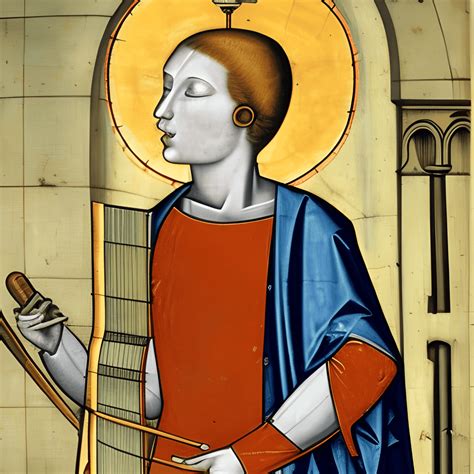
Guillame DuFay
Text and Translations
[COMING SOON: Blurb about DuFay songs]
Se la face ay pale
Se la face ay pale,
La cause est amer,
C’est la principale,
Et tant m’est amer
Qu’en la mer
Me voudroye voir;
Or, scet bien de voir
La belle a qui suis
Que nul bien avoir
Sans elle ne puis
Se ay pesante malle
De dueil a porter,
Ceste amour est male
Pour moy de porter;
Car soy deporter
Ne veult devouloir,
Fors qu’a son vouloir
Obeisse, et puis
Qu’elle a tel pooir,
Sans elle ne puis
C’est la plus reale
Qu’on puist regarder,
De s’amour leiale
Ne me puis guarder,
Fol sui de aguarder
Ne faire devoir
D’amours recevoir
Fors d’elle, je cuij;
Se ne veil douloir,
Sans elle ne puis
If my face is pale
If my face is pale,
The cause is bitter—
That is the primary reason—
And so bitter is it to me
That I would wish
To cast myself into the sea;
Yet, she to whom I belong
Knows full well, in truth,
That I can find no happiness
I can do nothing without her
If I bear a heavy burden
Of grief to carry,
This love is a cruel weight
For me to bear;
For it refuses to relent
Or yield its will,
Unless I obey
Its every command;
And since it holds such power,
I can do nothing without her
She is the most regal lady
One could ever behold;
I cannot guard myself
Against her loyal love.
I am a fool to look elsewhere,
Or to seek the favors
Of love from any
Other than her, I believe;
If I am to avoid despair,
I can do nothing without her
La belle se siet au pied de la tour
La belle se siet au piet de la tour,
Qui pleure et souspire et maine grand dolour.
Son père lui demande : « Fille qu’avez-vous?
Volez-vous mari ou volez-vous seignour ?»
« Je ne veul mari, je ne veul seignour,
Je veul le mien ami qui pourist en la tour.»
« Et par Dieu, belle fille, a celui faudrez-vous
Car il sera pendu demain au point du jour.»
« Et Père si on le pent, enfouyés moy dessous,
Ainsi diront les gens ce sont loyales amours.»
The beauty sits at the base of the tower
The fair maiden sits at the foot of the tower,
Weeping and sighing, in deep and bitter sorrow.
Her father asks her: “Daughter, what troubles you?
Do you desire a husband, or do you desire a lord?”
“I desire no husband, I desire no lord;
I desire my true love, who languishes within the tower.”
“Then by God, fair daughter, you shall surely lose him,
For he is to be hanged tomorrow at the break of day.”
“And Father, if indeed they hang him, bury me beneath him;
Thus shall the people say: ‘These are true and faithful loves.'”
Adieu ces bon vins de Lannoys
Adieu ces bon vins de Lannoys,
Adieu dames, adieu borgois,
Adieu celle que tant amoye,
Adieu toute playssante joye,
Adieu tout compaignons galois.
Je m’en vois tout arquant des nois
Car je ne truis feves ne pois,
Dont bien souvent au cuer m’ennoye.
Adieu ces bon vins de Lannoys,
Adieu dames, adieu borgois,
Adieu celle que tant amoye.
De moy serés par plusieurs fois
Regretés par dedans les bois
Ou il n’y a sentier ne voye;
Puis ne scaray que faire doye,
Se je ne crie a haute vois :
Adieu ces bon vins de Lannoys,
Adieu dames, adieu borgois,
Adieu celle que tant amoye,
Adieu toute playssante joye,
Adieu tout compaignons galois.
Farewell, those fine wines of Lannoy
Farewell, those fine wines of Lannoy,
Farewell, ladies; farewell, townsfolk;
Farewell to the one I loved so dearly;
Farewell to every pleasant joy;
Farewell, all you merry companions.
I am off to go gather nuts,
For I can find neither beans nor peas—
A lack that often weighs heavy on my heart.
Farewell, those fine wines of Lannoy,
Farewell, ladies; farewell, townsfolk;
Farewell to the one I loved so dearly.
You shall be, time and again,
Remembered and longed for deep within the woods,
Where there is neither path nor road;
And then, not knowing what else to do,
I shall have no choice but to cry out aloud:
Farewell, those fine wines of Lannoy,
Farewell, ladies; farewell, townsfolk;
Farewell to the one I loved so dearly;
Farewell to every pleasant joy;
Farewell, all you merry companions.