

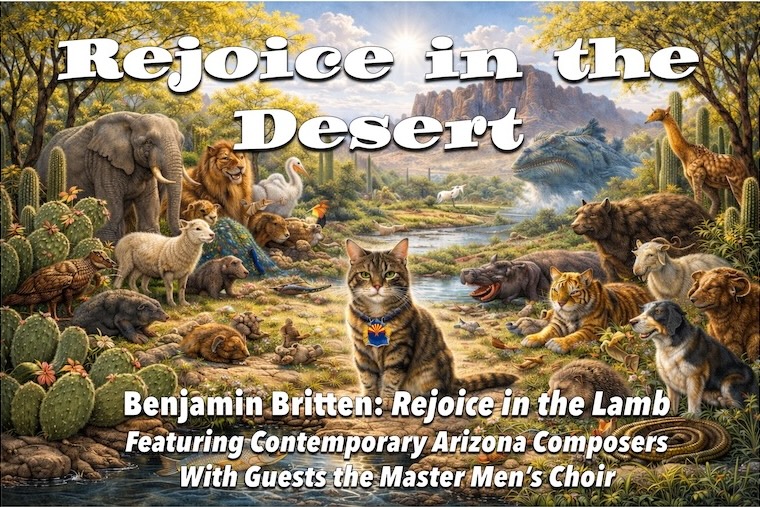
Rejoice in the Lamb
(And lots of other animals, too!)
Program Notes
Rejoice in the Lamb
A Festival Cantata
Benjamin Britten (1913–1976)
The Source: Christopher Smart and Jubilate Agno
The text of tonight’s cantata was drawn from one of the most extraordinary documents in English literary history. Christopher Smart (1722–1771) was a gifted poet, a Cambridge scholar, and a translator of the Psalms—but he was also a man whose faith was so intense and so publicly expressed that it alarmed the society around him. In 1759, he was confined to St. Luke’s Hospital for Lunatics in London, and it was during those years of confinement that he wrote Jubilate Agno (“Rejoice in the Lamb”), a vast, sprawling, visionary poem that he never intended for publication.
The manuscript was not discovered until 1939—the very year young Benjamin Britten would encounter it—and was first published in 1954. Smart modeled his poem on the antiphonal structure of Hebrew poetry, with alternating lines beginning “Let” and “For,” echoing the call-and-response of the Psalms. The result is something utterly unlike any English poem of the 18th century: part prayer, part natural history catalogue, part mystical vision, and part joyful madness.
Smart drew his creatures, his images, and his theology from the King James Bible, from contemporary natural history, and from his own blazing interior life. He believed that all creation — every animal, every plant, every letter of the alphabet — was engaged in the praise of God simply by existing. The poem’s very incoherence became, in his conception, a form of holiness: the praise of creation cannot be systematized, only enumerated.
For I will consider my Cat Jeoffry. / For he is the servant of the Living God, duly and daily serving him. / For at the first glance of the glory of God in the East he worships in his way.
The celebrated passage on Jeoffry—Smart’s actual cat, his companion in confinement—has become one of the most beloved passages in English poetry. It is not merely charming; it is theological. Jeoffry’s daily routines—stretching, hunting, washing his face—are read as acts of liturgy, a cat’s equivalent of the divine office. Smart’s genius was to see grace in the particular, the ordinary, and the overlooked.
Smart also wrote with remarkable self-awareness about the nature of his confinement. He understood that what the world called madness—his habit of praying aloud in the street, of dropping to his knees at any moment to give thanks—was, in his own reckoning, simply obedience to God. “For I blessed God in St. James’s Park till I routed all the company,” he wrote without apology.
The Music: Benjamin Britten’s Setting
Britten composed Rejoice in the Lamb in 1943, at the request of Walter Hussey, vicar of St. Matthew’s Church in Northampton, for the church’s 50th anniversary. Britten was thirty years old, recently returned from America, and at the beginning of the extraordinary creative decade that would produce Peter Grimes, The Young Person’s Guide to the Orchestra, and the Spring Symphony. He had encountered Smart’s newly rediscovered manuscript at just the right moment.
The work is scored for soprano, alto, tenor, and bass soloists, SATB chorus, and organ. It is compact—roughly twenty minutes in performance—but every minute is saturated with invention. Britten selected eight passages from Smart’s poem with great care, shaping them into a coherent arc that moves from cosmic praise, through creature-song and human fallibility, to final jubilation.
The Architecture of Praise
The cantata opens with the full chorus in a brilliant C major, the voices cascading over an exuberant organ accompaniment. Britten sets Smart’s opening invocation—“Rejoice in God, O ye Tongues”—with irresistible momentum, the words tumbling forward as if praise itself cannot be contained. Listen for the way Britten makes the organ feel like a great wind filling the space.
After this jubilant opening, the work turns inward. Each of the four soloists takes a distinctive passage, and Britten’s characterizations are masterly.
The Soloists: Four Portraits
The countertenor (or alto) solo sets the Jeoffry passage, and it is one of Britten’s most quietly remarkable achievements. The vocal line is sinuous and almost improvisatory—it mirrors a cat’s unpredictable movement. The organ provides delicate, shimmering commentary, never quite settling into a regular pulse. Britten understood that Jeoffry’s praise is instinctive, not disciplined, and he wrote music that feels the same way.
The tenor solo addresses the mouse and its smallness before God—“For the Mouse is a creature of great personal valour”—with music that is wiry and fleet, almost comic in its energy. The bass solo takes on the more somber material about the flowers and the lamb, music of quiet gravity and warmth. The soprano’s section, often the most ethereal, soars above the organ in music of rapt, otherworldly beauty.
The Hallelujah and the Instruments
One of the most striking moments in the cantata is Smart’s catalogue of instruments of praise—the harp, the lute, the viol, the organ—which Britten sets for the full chorus with a series of distinct musical gestures for each instrument. The organ shifts its registration as each instrument is named, and the choral texture changes accordingly. This is tone-painting of a high order: Britten is not merely illustrating the text but enacting it, making the organ itself become, in turn, each of the instruments named.
The final chorus returns to C major with the full forces reunited. Britten builds the closing pages with great cumulative power, layering the voices and organ until the final “Hallelujah” rings out with a sense of arrival that feels both inevitable and joyful.
What to Listen For
Here are specific musical moments and ideas to hold in your ears as you listen tonight:
- The opening organ fanfare: Notice how Britten uses the organ’s full resources from the first measure, establishing both the grandeur of the subject and the festive character of the occasion. The writing is deliberately extrovert—this is music that knows it is in a church and wants to fill one.
- The Jeoffry solo: Listen for the absence of a clear meter. Britten blurs the barline, giving the vocal line a floating, feline freedom. The organ’s soft, high-register responses feel like a cat’s watchful stillness between movements.
- The instruments passage: As the chorus names each instrument—harp, lute, viol—listen for how the organ’s texture changes with each one. This is musical ventriloquism of a quiet, joyful kind.
- Harmonic language: Britten’s tonal world here is warm and largely diatonic, but watch for the moments when the harmony slips into unexpected territory—a sudden modal turn, a chromatic shadow—when the text touches on human weakness or the strangeness of creation. The brightness always returns, but Britten does not let the praise become naive.
- The relationship of soloists to chorus: Notice how the soloists seem to speak for the individual creature or the individual soul, while the chorus always represents the collective voice of creation. Smart’s poem moves between the one and the many, and so does Britten’s music.
- The final Hallelujah: It is not a long buildup, but it is a decisive one. Britten saves his grandest choral writing for the end, and when the full forces converge on the final cadence, the effect is of a great gate swinging open. Smart believed all creation was always already praising God; Britten’s ending makes you feel it.
A Note on the Poet
Christopher Smart died in a debtors’ prison in 1771, his poem unread and unpublished. His rehabilitation as a major poet was slow; even today he is not as widely known as he deserves to be. Britten’s cantata, more than any other single work, has brought Smart’s vision to audiences who would otherwise never have encountered it. Tonight, as you hear these words set to music of such generosity and craft, you are also—in some sense—hearing Smart’s own vindication: his conviction that praise, in all its strange and particular forms, is never wasted.
The Creatures of Rejoice in the Lamb
Christopher Smart believed every created thing praises God simply by being itself—and he populated his poem with creatures great and small as witnesses to that praise. Together they make Smart’s central argument: praise is not a human invention. It is what the universe was already doing.
The Lamb is the cantata’s governing symbol — Christ himself, the Lamb of God, but also the gentlest of created things. Smart’s title invites all creation to join the lamb in praise, and Britten’s music returns again and again to its quality of innocent, unguarded joy.
Jeoffry the Cat is the cantata’s heart and the poem’s most celebrated figure, and Britten gives him his own extended solo with floating, meterless music that perfectly captures a cat’s unhurried, instinctive grace. Smart’s actual companion during his confinement, Jeoffry embodies the idea that every creature worships God through its own nature — a cat by being perfectly, instinctively a cat. His daily routines of stretching, hunting, and washing are read as acts of liturgy.
The Mouse appears in the tenor solo with the line “For the Mouse is a creature of great personal valour.” Smart sees in the mouse’s smallness and vulnerability not weakness but courage — even the least of creatures presses forward in praise. In Smart’s vision no creature is too small for glory.
The Flowers (particularly the rose and the lily) stand for the beauty of creation that praises God simply by blooming. Smart links specific flowers to specific spiritual qualities, continuing the medieval tradition of reading nature as a book of divine meaning.
The Elephant and the Ant appear together in Smart’s vision of scale — the greatest and smallest of land creatures, both equally enrolled in creation’s choir. No creature is too grand or too humble to be included.
The Whale and the Leviathan open the cosmos outward and represent the deep and the vast — creatures beyond human comprehension or control, yet subject to God. Their presence in the poem gives the praise a cosmic dimension that balances the domestic warmth of Jeoffry.
The Lamb, the Kid, and the Sheep recur throughout as pastoral images linking the English countryside to biblical landscape — Smart was deeply read in both, and saw no gap between them.
The Wren is specifically celebrated by Smart as the smallest of English birds and therefore, in his inversion of worldly values, among the greatest of praisers. Smallness is not a disadvantage in Smart’s theology; it may be a distinction. (Note: The Cactus Wren is the Arizona state bird.)
The Servants of God — while not animals, Smart frequently places named human figures alongside creatures, suggesting that the boundary between human and animal praise is thinner than we suppose. All are creatures; all are called to the same song.
Arizona Masterworks Chorale • Program Notes • © 2026